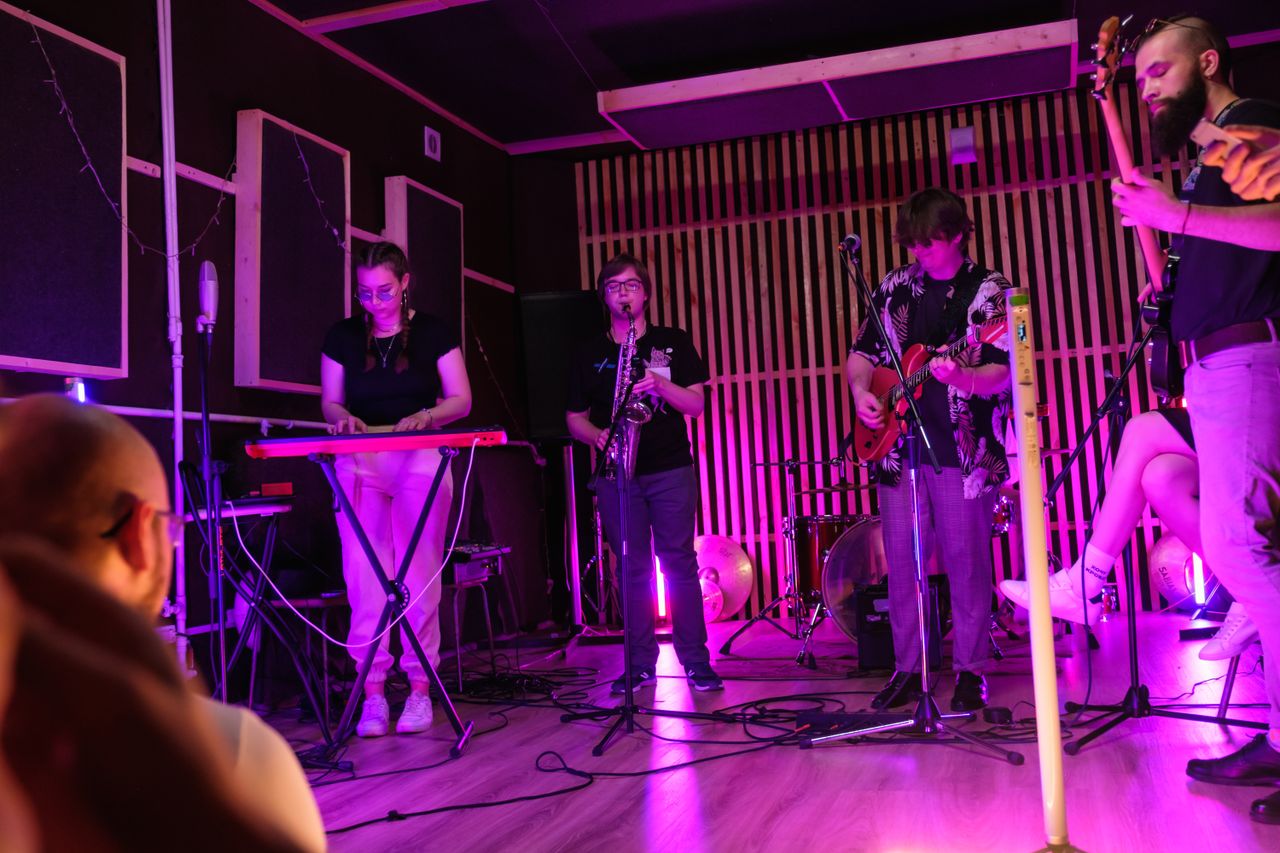
Small live-venue context · Pexels free-use photo
Last verified: September 25, 2026 · Current regulation and announced reform direction reviewed.
A Korean live-music venue can legally host a band and still get into trouble if customers are judged to be dancing. That happened to Ovantgarde, an independent music venue and pub in Busan that was ordered to suspend business for two months in 2026.
Korea does not have a general ban on dancing, and live performance itself was not the problem. Ovantgarde operates under a general restaurant business classification. Current food-sanitation rules restrict general restaurants from allowing customers to dance as part of the business.
The government has now said that the rule should be changed for live-music venues. As of September 25, however, the nationwide rule has not yet been replaced.
How a live venue ends up classified as a restaurant
Small Korean music venues do not operate like arena concerts.
Many have a modest stage, a bar, tables and space for a few dozen or a few hundred people. Ticket revenue alone may not cover rent, staff and equipment, so selling drinks or food becomes part of the business model.
Korean regulations began allowing live musical performance in general restaurants after changes in the late 1990s. That made it possible for small music venues to operate legally without becoming large formal performance halls.
One problem remained: the rules governing general restaurants still restricted businesses from allowing customers to dance.
That restriction was designed largely to stop ordinary restaurants from operating like nightlife or entertainment establishments without the corresponding business classification. Applied to a small rock venue, however, the same wording can cover behavior that audiences consider part of watching a concert.
Live music in a general restaurant can be permitted. Allowing customer dancing can still trigger a separate food-sanitation issue. The conflict becomes visible when a standing concert audience moves naturally to the music.
What happened at Ovantgarde
Ovantgarde is in Busan’s Nam-gu and has operated as a music venue and pub for years, hosting Korean and international independent bands.
In August 2026, authorities visited the venue following an unrelated complaint. The original complaint did not become the central issue. Officials instead observed a live performance and concluded that the venue had allowed customers to dance in violation of the rules attached to its restaurant license.
The venue disputed that description, saying the audience had been standing and naturally responding to the performance.
The administrative penalty was a two-month business suspension. Under the applicable enforcement structure described in reporting on the case, repeated violations can bring progressively stronger sanctions.
For a small venue, even a first suspension is expensive. Rent and other fixed costs continue while scheduled shows are canceled.
Third-party footage from an actual 2026 Ovantgarde show, useful for understanding the scale and standing-live-show context of the venue. Korea Trends Explained did not film this performance.
Open on YouTube →
Standing, moving and “dancing” are hard to separate at a concert
The wording becomes awkward once it reaches actual performance culture.
A customer who enters a nightclub specifically to dance is easy to picture. A fan at an indie-rock show may stand near the stage, move with the music, jump during a chorus or sway while watching the band.
Where does ordinary audience response become legally relevant “dancing”?
Ovantgarde’s case brought that ambiguity into public view because the owners and supporters argued that authorities were treating normal concert participation as if the venue were operating an unlicensed entertainment business.
This is also why headlines saying “dancing is illegal in Korea” are misleading. People dance at concerts, festivals, clubs, studios and public events across the country. The Ovantgarde dispute concerns a specific combination of business classification, customer behavior and food-sanitation rules.
The legal gap is older than Ovantgarde
Independent musicians and venue operators have argued that Korea lacks a sufficiently clear legal category for small live-music spaces.
A venue may function culturally as a performance space but commercially rely on a restaurant license because it serves drinks and cannot support itself on admission charges alone.
That arrangement worked while enforcement was flexible enough to accommodate ordinary concert behavior. It becomes much more fragile when standing and movement are interpreted as prohibited entertainment activity.
Enforcement can also differ by local jurisdiction. Some districts have developed ordinances or administrative practices that better accommodate live music. That does not erase the underlying nationwide rule.
Lawmakers proposed two kinds of fixes
The Ovantgarde case produced more than social-media criticism.
Musicians, organizers and venue operators submitted a National Assembly petition in August calling for changes to the Food Sanitation Act and Public Performance Act. The petition asked for clearer treatment of small performance spaces and for a distinction between ordinary audience response and nightlife-style entertainment activity.
Lawmakers subsequently introduced proposals from different directions.
One approach would create or recognize a small performance facility category, giving small live venues a legal position better matched to the way they actually operate.
Another approach would protect ordinary standing, movement and audience response during performances from being treated automatically as prohibited dancing at a general restaurant.
The details matter because changing the performance law alone and changing food-sanitation enforcement are not necessarily the same thing.
The government has backed reform, but the rule still exists
Culture Minister Chae Hwi-young publicly addressed the issue in August and again at a popular-music policy meeting on September 17.
The government said the Enforcement Decree of the Food Sanitation Act needs to be updated because the present restriction no longer fits the reality of small live-music venues.
That is a meaningful policy signal. It is not the same as an amendment already taking effect.
Government officials have said the rule should be changed, and bills have been introduced. Do not describe the dance restriction as already abolished nationwide. The legal and regulatory amendment process is still underway.
What this means for a visitor
A foreign visitor does not need to inspect a Korean venue’s business registration before attending every show.
The useful point is narrower: English words such as live club, music bar and venue describe the audience experience, not necessarily the establishment’s Korean legal classification.
Two places that look almost identical — small stage, beer, standing crowd — may operate under different registrations or local rules.
Until the national rules change, a venue itself remains responsible for managing the restrictions attached to its license. If staff ask customers not to move tables, stand in a particular area or dance, the request may have a regulatory reason that is invisible to someone simply looking at the stage.
The Ovantgarde dispute has turned that obscure distinction into a national policy question. The next important update is the actual amendment text and its effective date.
Two Korea Desserts
Official VISIT BUSAN video for a wider look at the city behind its independent music scene.
Open on YouTube →
Post a Comment