Jennie’s blue eye detail in How You Like That began with blue shadow at the inner corners. Makeup artist Lee Myeong-seon, known as Maeng, explained that the color did not appear under the lights as strongly as Jennie wanted. She added matching gems over the shadow, then paired straight wings with gems near their ends. Allure reported the account in July 2020.
The addition kept the original color idea while giving it another surface. A viewer could now read a small blue area and a sharper, changing highlight within the same design. That difference is worth looking at closely: a camera records reflected light, not the color name printed on an eyeshadow pan.
Blue under the lights
A makeup mirror and a finished music video are different viewing conditions. At the mirror, someone can lean closer, turn a light or study one eye for several seconds. In a video, the face occupies a chosen part of the frame, moves through a shot and shares the image with everything around it. The viewer cannot lean into the set to recover a detail that has become hard to see.
Nikon’s explanation of white balance shows why the illumination matters even before a makeup artist changes a product. Different light sources can give an image a warmer or cooler cast, and the camera’s white-balance setting changes how that cast is rendered. A surface that looks one way in person can therefore be reproduced differently in an image.
That does not identify the technical cause on this particular shoot. The account does not supply its exposure settings, lighting plan or color-grading decisions. It supports a narrower point: the people making the image were dissatisfied with how the detail appeared under the lights. Reconstructing an exact camera fault from the finished video would go beyond the evidence.
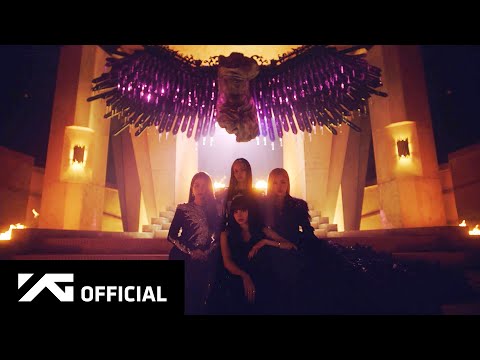
BLACKPINK — How You Like That
The original 2020 music video is the visual reference for this article. Watch the blue details at the eye corners, rather than treating every look in the video as the same makeup. This is a music video, not an English-language tutorial.
Watch on YouTube
The surface of a small gem
Consider two possible adjustments to a blue eye accent. More shadow could make the colored area larger or more opaque. A reflective decoration can add a small highlight whose position and intensity depend on its angle to the light and camera. The two adjustments affect different parts of the image. They can also be used together.
In OpenStax’s account of reflection, smooth and rough surfaces return incoming light differently. A smooth surface can reflect light in a concentrated direction; an uneven surface scatters it across more directions. A faceted decoration has several small surfaces, so a change of angle may make one facet catch the light while another becomes less bright.
This is a general optical explanation, not a laboratory analysis of the stones used in the video. Their material and surface treatment have not been established here. Eyeshadow is not one uniform material either: matte, shimmer and glitter formulas produce different finishes. It would be inaccurate to treat every powder as flat and every gem as equally reflective.
The useful comparison is between a broader colored mark and a more localized reflection. A gem does not generate its own light. It needs suitable illumination, and it may look relatively quiet from an unhelpful angle. Adding sparkle cannot guarantee that a detail will remain visible in every shot.
Placement around the eye
Read as a composition, an inner-corner accent and a wing-end accent give the eye two separated points of interest. The line between them supplies direction. This is our reading of the arrangement, rather than a claim that Maeng described it in those terms.
Imagine shifting the same decorations into a continuous row along the upper lid. Their color and shine could stay similar, but the arrangement would become a band. Spread them farther across the temple and they would occupy a larger part of the face. Keep them close to the corners and they remain attached to the eye’s outline. Placement changes the design without requiring a different product.
The spaces between the elements deserve attention too. Filling every gap with shadow, liner or decoration would create a denser area. Leaving some skin visible allows separate marks to remain separate. Neither approach is inherently better; they produce different relationships between a line, a colored patch and a bright point.
A still image and a moving face
A screenshot holds one instant of reflection. A video can show that reflection appearing, shifting and fading as the face moves. This is why a paused frame is useful for locating a decoration but incomplete as a description of its behavior. A tutorial copied from a single still may reproduce the placement while missing the changing light that made the detail noticeable.
Scale adds another constraint. When an image of a face is reduced, every small feature takes up fewer pixels. A mark that is easy to inspect in a large close-up may be difficult to separate from nearby makeup in a wider image. This follows from the size of the image; it does not establish that a particular decoration increases attention or memorability.
For the same reason, a close-up and a wider shot answer different visual questions. The close-up reveals edges and individual pieces. The wider shot shows how much of the face the design occupies. Neither view alone tells us the brand of the shadow, the adhesive used or how the makeup felt during filming.
Looking at the finished design
On a second viewing, follow the eye corners through movement rather than judging the look from one thumbnail. Notice the relationship between the colored area, the black line and the momentary highlights. Then compare a close-up with a wider frame. These are features the finished image lets a viewer examine without inventing a backstage technique.
The scope remains one documented 2020 production. It provides no basis for naming Jennie’s current everyday products or turning this placement into a rule for all her makeup. The original video and the artist’s account are the relevant references; a present-day shopping list would require different evidence.
Dessert
K-pop
BTS — Merry Go Round
An ARIRANG track, with its official music video released on YouTube in September 2026. BANGTANTV.
Watch on YouTube
Korean percussion
Janggu and samulnori
A traditional-percussion video linked by the National Gugak Center’s English-language education page.
Watch on YouTube
Post a Comment