Updated: September 30, 2026
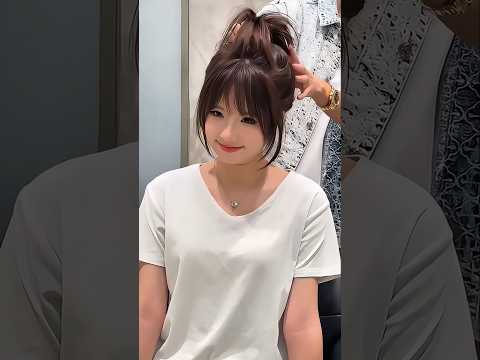
Long face-framing layers can almost disappear when the hair is worn down. The shorter pieces lie against the same mass of hair as everything behind them, especially after a smooth blowout. Put that hair into a ponytail and some of those pieces are suddenly left on their own around the cheeks and jaw.
Korean salon guides describe face-framing layers as shorter sections cut around the front of the face, often beginning somewhere between the cheekbone and collarbone and blending into the longer haircut behind. What happens when the hair is tied depends on those lengths, the amount of hair in the front section and the way it has been styled.
Why the front can look almost seamless with the hair down
Face framing does not have to look like a separate fringe.
A shorter piece near the cheek can move into a jaw-length section, then into longer layers below the shoulder. When those transitions have been blended carefully and the hair is falling in the same direction, the eye tends to read one continuous outline rather than a stack of steps.
Miin Hair describes Korean face framing as a technique-led approach using methods such as slide cutting, point cutting and graduated layering to make the front pieces merge more smoothly into the rest of the haircut.
The salon terms are less important to a client than the photograph they produce. In a front-facing image, the first short layer may be difficult to locate. Turn the head, let the wind move the hair or tuck the longer section behind the shoulder, and the shorter piece becomes easier to see.
Styling can exaggerate that difference. A piece curved inward around the cheek separates from the hair behind it. The same length dried almost straight can blend back into the main body.
Watch on YouTube
Once the longer hair goes back
A low ponytail changes the background around those short sections.
Hair long enough to reach the elastic gathers behind the head. Pieces that are too short, or that have been intentionally left loose, remain near the face. A front layer that looked like a small part of a long haircut can become one of the most visible lines in the hairstyle.
How much remains varies considerably.
Some cuts leave one or two long pieces around the jaw. Others have several visible lengths near the temple, cheek and chin. On another haircut, almost the entire front can be swept into the ponytail.
Higher ponytails can pull side hair at a steeper angle and make loose pieces look more separate in some examples. Low ponytails often leave the surrounding hair moving backward on a gentler line. Neither effect is guaranteed; natural growth direction, density and the exact location of the layers can change it.
Front layers can merge into the surrounding length, especially when everything is styled in the same direction.
Longer sections move back while shorter face-framing pieces may remain around the cheek and jaw.
More of the long hair disappears from the front view, making loose pieces easier to notice in some cuts.
Where a front piece ends becomes very obvious
Face-framing descriptions often focus on the starting point: cheekbone, jaw or collarbone.
In hair-up photographs, the finishing length can be easier to read.
A piece ending around the cheek has little chance of joining a low ponytail. A longer section reaching below the jaw may be tucked behind the ear or swept back. Collarbone-length framing can look substantial when the hair is loose and then nearly disappear once everything is gathered.
That difference explains why two people can both ask for “face-framing layers” and receive very different ponytail silhouettes.
One cut may leave a deliberate group of loose front pieces. Another may have long, blended framing that mainly shows when the hair is down and moving.
Curl changes the apparent length
The length seen in a finished salon photograph is not always the straight length of the strand.
A C-shaped bend can pull the end inward toward the cheek. An outward flick separates it from the longer hair behind. A stronger S-shaped movement uses more of the strand inside the curve, so the piece can appear shorter in the finished image.
Korean salon photography frequently combines layered cuts with blowouts or perms, which makes the cut and styling difficult to separate at first glance.
If a reference photo has very curved face-framing pieces, a straighter image of the same haircut can be useful before deciding where the actual cut length should sit.
Before making the pieces shorter
Someone with long hair can experiment with how much hair is left outside a low ponytail without pretending that this reproduces a new haircut.
Pulling out a small section near the temple, then a slightly larger section near the cheek, can show how comfortable it feels to have loose hair around the face. It cannot predict the movement of a properly cut layer or how that layer will blend when the hair is worn down.
For the salon, two photographs are often enough to make the request clearer: one with the desired haircut loose, and another showing a tied style with roughly the amount of framing you want left at the front.
The stylist can then see both the blend and the loose pieces rather than having to infer everything from the phrase “face-framing layers.”
Dessert
K-pop · September 2026
ROSÉ — new trick
ROSÉ’s official September 2026 music video.
Watch on YouTube
Incheon · Songdo
Songdo Central Park at Sunset
A walk through Songdo Central Park as the modern skyline changes from daylight into evening.
Watch on YouTube
Post a Comment