Updated: September 30, 2026
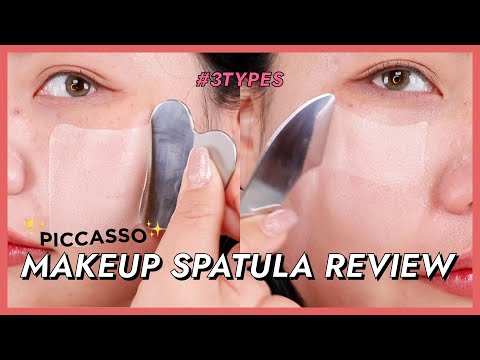
The oddest part of a Korean makeup-spatula demonstration arrives after the spatula has already done its job. A makeup artist picks up a small amount of liquid foundation, draws the thin metal edge across the skin and leaves behind a fine layer. Then another tool appears: a puff or sponge starts tapping over the same area.
If the spatula was supposed to replace the sponge, the sequence makes no sense. It makes much more sense when the two tools are given different jobs. The spatula distributes foundation into a thin film. The puff works on that film after it has been placed—pressing, blending edges and handling areas where a flat metal edge is less useful.
Before the tool touches the face
The technique begins with product amount.
In Glamour’s interviews with makeup artists familiar with the Korean spatula method, Los Angeles-based Korean makeup artist Pircilla Pae described working with less than a full pump of liquid foundation. The product goes onto the back of the hand, and the narrow edge of the spatula passes through it before application to the face.
That small detail changes the mental picture of the tool. It is not a miniature trowel carrying a mound of foundation. The edge meters and moves a relatively small amount of product.
Another makeup artist interviewed for the story, Hyemin Jo of Jennyhouse, described a spatula followed by a sponge as part of creating a smooth, natural-looking base. The two-tool sequence existed before the spatula became a mass-market beauty trend.
Current retail also reflects that pairing. Piccasso’s global site still lists its Makeup Spatula, and the brand sells a Makeup Spatula & Sponge set. The product architecture itself makes more sense when spatula and sponge are seen as consecutive tools rather than substitutes fighting for one job.
Spread: a thin film rather than a pile of product
Watch a flat cheek area first. The metal edge passes across the skin and leaves foundation behind it. The movement resembles coating a surface more than stippling it.
How thin the result becomes depends on the amount loaded onto the tool, the angle, pressure, speed and the foundation’s viscosity. A spatula does not contain a built-in millimeter setting that guarantees the same film for every user.
Still, the geometry is useful. A narrow, smooth edge can pull a small pool of liquid across a wider area. Instead of placing several large dots and trying to redistribute them later, the product begins its life on the face already spread out.
This is one reason videos of the technique are satisfying to watch. The visible transformation happens before the makeup is finished: an opaque-looking bead of liquid becomes a much thinner layer.
Calling that layer “thin” does not automatically mean sheer coverage. A high-pigment foundation can remain visually opaque even in a relatively fine film. A sheer foundation can stay sheer after more product is applied. Tool thickness and formula coverage are related, but they are not the same property.
Immediately after the spatula passes
Freeze the demonstration before the puff arrives.
The base may already look even from normal viewing distance. Up close, there can still be faint tracks where the edge moved, a heavier boundary at the end of a stroke or product sitting differently around pores and facial hair.
Curved areas create another problem. A flat metal edge is comfortable on the broad plane of a cheek; the sides of the nose, corners around the nostrils and contours around the mouth are not broad planes.
This intermediate stage is missing from many before-and-after beauty images. The viewer sees bare skin, then a finished base, and the tool in the middle receives all the credit.
The unfinished frame is more instructive. It shows the spatula’s actual contribution and the work still left for the next step.
The puff enters because the motion changes
Watch on YouTube
With a puff or sponge, the hand is no longer dragging a metal edge across the face. The motion becomes short presses and taps.
Glamour’s account of Pae’s process describes a foundation wedge being lightly patted over the product after spatula application. That second movement can soften visible borders and work the foundation across areas where the first pass is less even.
The word press is useful because it explains why the puff is not redundant. It is interacting with a layer that already exists.
Aggressive rubbing would be a different technique. So would loading the puff with a large second dose of foundation and starting over. The characteristic sequence is more restrained: distribute first, then finish the distributed layer.
Second pass: coverage becomes local
A thin first layer changes how the next decision is made.
If the center of the cheeks already looks even but redness remains around the nose, there is no reason to rebuild the entire face to the same thickness. Additional product can be placed where the first layer does not provide enough visual coverage.
Pae’s description in Glamour also mentions layering certain areas when more coverage is needed. That makes the technique less about “using almost no foundation” and more about separating two choices: baseline coverage across a broad area and additional coverage in selected areas.
The sequence can be useful even for someone who does not want a glass-skin finish.
A matte foundation can still be spread thinly and layered locally. A satin foundation can still be over-applied. The spatula does not create one compulsory finish; the formula remains a major part of the result.
| Stage | Primary job | Common mistake when reading the technique |
|---|---|---|
| Spatula | Distribute a small amount across the skin as a thin layer. | Assuming the metal tool alone creates the final smooth finish. |
| Puff / sponge | Tap and press the existing layer, blend visible edges and work around contours. | Treating it as unnecessary because foundation is already on the face. |
| Spot layer | Add coverage only where the first pass is insufficient. | Reapplying the same amount everywhere and losing the thin-base logic. |
Foundation formulas do not behave alike
A tool tutorial can look deceptively universal because the hand movement is easy to copy. The liquid on the spatula may be doing half the work.
A fluid foundation with enough slip can travel cleanly behind the edge. A thick cream formula may gather differently. A fast-setting long-wear base can begin forming a film before a large section has been completed. A formula with substantial volatile solvents can change texture while the user is still working.
Glamour’s artist discussion centers on liquid foundation, and Pae specifically names fluid formulas she finds easy to blend. That context should stay attached to the technique.
If a different foundation drags, balls up or sets very quickly, copying the same number of strokes from a tutorial may not reproduce the tutorial’s finish.
The practical experiment is smaller: try the tool with the formula you already know, observe how far a small amount travels, and see whether the puff can finish the layer before the base sets. The result tells you more than a universal “spatula works with everything” rule.
Coverage and thickness are not the same dial
Beauty videos often make a thin layer look almost contradictory: if there is less product, why does redness still disappear?
Coverage depends on the foundation itself as well as application thickness. Pigment concentration, color match, opacity and how evenly the film is distributed all affect what remains visible underneath.
A strongly pigmented foundation can cover a great deal in a thin application. A very sheer formula may still show discoloration after a thicker layer. The spatula does not manufacture extra pigment.
Its contribution is placement.
Spreading a small amount into a consistent film may reduce areas where excess product has accumulated. Adding a second pass only where necessary can preserve that lighter overall construction.
This is also why “spatula gives better coverage” is too crude. It may help someone use an existing foundation differently. The coverage capacity belongs to the foundation-and-application combination.
A smooth-looking pore is still a pore
Another common demonstration claim concerns pores.
A base that distributes pigment evenly can make shadows and color differences around pores less visible. A puff can also change how excess foundation sits around surface texture. Under soft lighting, the finished skin may appear dramatically smoother.
The pore has not disappeared.
Camera distance, exposure, lens choice and lighting direction also affect how much surface texture appears in a video. Comparing a bare-skin macro shot with a finished face from farther away exaggerates the tool’s apparent transformation.
A useful demo keeps angle and distance reasonably consistent. Even then, the result shows a cosmetic change in appearance, not a change in pore anatomy.
Metal does not make the routine automatically hygienic
A stainless-steel tool looks easy to clean, and that can be an advantage when it is actually cleaned between uses.
The material does not clean itself.
A spatula repeatedly placed onto the hand, palette, foundation and face without cleaning can carry residue just as another reusable tool can. Sponges and brushes also need appropriate care.
Hygiene therefore belongs to maintenance, storage and cleaning practice. It should not be used as a blanket reason that a spatula is inherently superior to fingers, a brush or a puff.
No kitchen substitution is needed
The resemblance to a small painting knife or blunt blade has inspired improvised substitutes online. There is no beauty advantage in bringing a sharp household blade close to the eyes, nose or moving parts of the face.
Purpose-made makeup spatulas are designed as cosmetic tools with blunt, finished edges. Piccasso’s current international shop still lists its makeup spatula as a dedicated beauty tool, along with sponge pairings and other base-makeup tools.
The technique is interesting because of how product is spread, not because metal near the face is inherently special.
The twenty seconds worth replaying
If you only watch a short section of a makeup-spatula video, choose the transition between tools.
Look at the cheek before foundation. Watch how much product is picked up. Follow one clean spreading pass. Pause before the puff touches the same section and notice any edges or streaks. Then watch the tapping stage and compare that exact area again.
That short sequence answers the article’s question better than a polished final portrait.
The spatula has already applied foundation when the puff appears. The puff returns because application and finishing have been divided into two movements.
Once that distinction is visible, the tool stops looking like a strange Korean beauty gadget. It becomes a fairly logical way of controlling where a liquid foundation goes, how thin the first layer begins, and where more coverage is added afterward.
Dessert
K-pop · September 2026
LE SSERAFIM — Made My Night
The official September 2026 music video, released through HYBE LABELS / SOURCE MUSIC.
Watch on YouTube
Korean temple culture
Temple Stay in Korea — Dive into Korea
KOREAZ follows a day at Cheonchuksa, including meditation, a monastic meal and tea. Produced by Korea’s Ministry of Foreign Affairs channel.
Watch on YouTube
Post a Comment